
The difference between ranking on Google and getting recommended by AI-powered search
The new playbook for getting found, and how Sparq is adapting to it
The difference between ranking on Google and getting recommended by AI-powered search
At Sparq, we have spent years helping brands earn a spot in front of the right audience, whether that meant a well-timed Instagram post, a branded photoshoot outside a favorite lunch spot, or a strong Google listing for a shopping center down the street. The playbook for getting found has always evolved, and right now it is evolving faster than most businesses realize.
For the past two decades, getting found online has meant ranking on Google. Optimize your keywords, build authority, keep your site fast, and hope you land on page one. That still matters. But a new layer has formed on top of it, and it changes what "getting found" actually means.
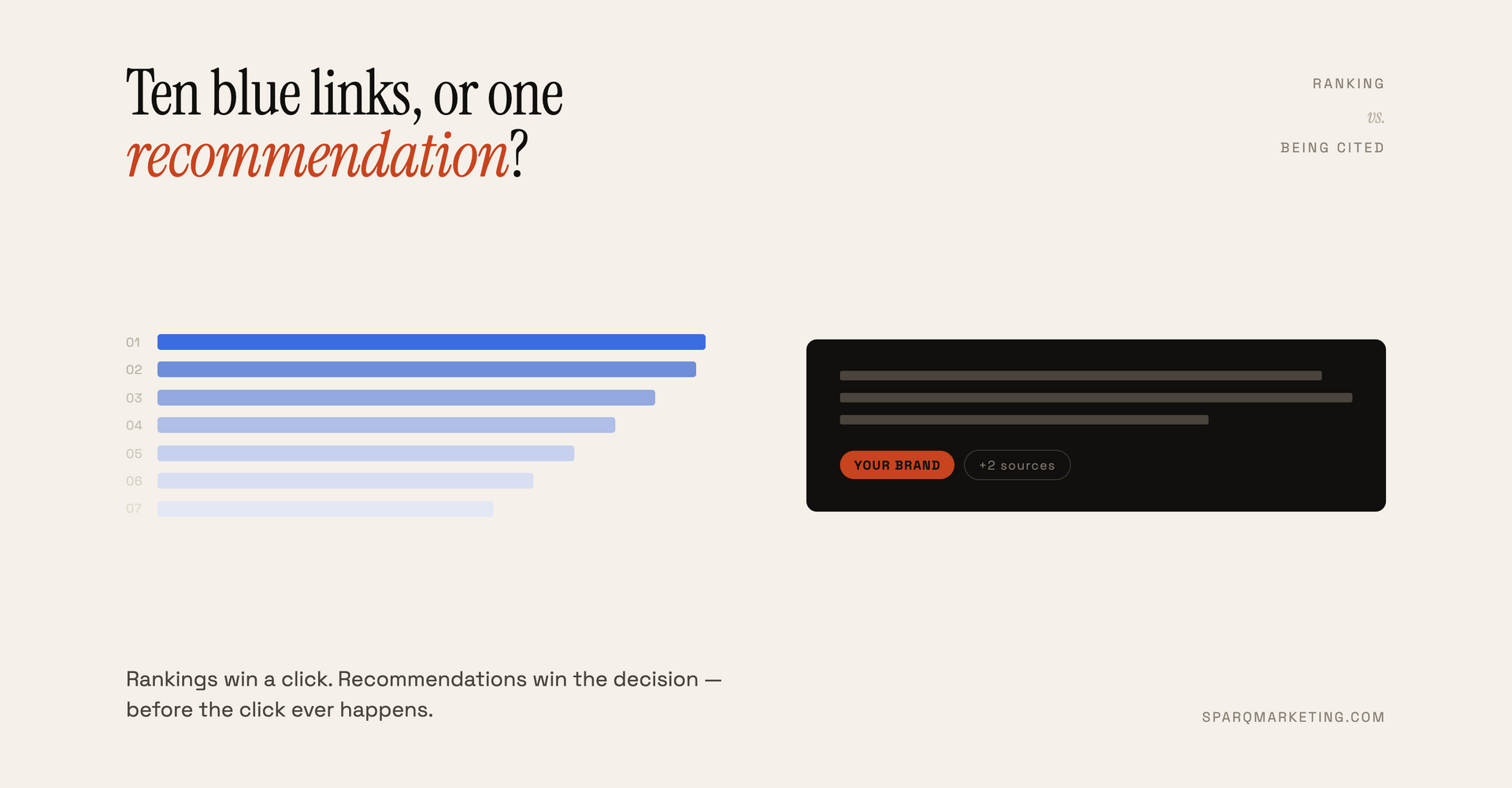
When someone asks ChatGPT, Perplexity, or Google's AI Overviews a question, they are not scrolling through ten blue links and deciding for themselves who to trust. The AI is making that call for them. It reads across the web, synthesizes an answer, and often names specific businesses by name, before the person ever clicks anything.
This is a fundamentally different game, and understanding the difference is the first step to competing in it.
Ranking is about matching. Recommendation is about trust.
Traditional SEO is built around matching intent to content. Someone types "best marketing agency near Danville," Google matches that query against pages with the right words, solid technical performance, and enough authority signals to rank well. If you check those boxes, you show up. The user still does the work of comparing options and deciding who to contact.
AI-powered search collapses that process. The AI reads many sources at once, cross references them, and produces a single synthesized answer. Instead of showing ten options and letting the user pick, it narrows the field to two or three names it is confident recommending.
That shift means the AI is not just matching your content to a query. It is evaluating whether your business is credible enough, consistent enough, and clearly described enough to vouch for. You are not optimizing for a search algorithm anymore. You are auditioning for an endorsement, the same way we have always coached our clients to earn trust with their own community, just at a much larger and less visible scale.
Where the two approaches actually diverge
A few concrete differences show why the strategies are not interchangeable.
Keywords matter less than clarity. Google rewards content that closely matches search phrasing. AI models care more about whether your business is described in a way that is easy to summarize accurately. If an AI cannot clearly explain what you do and who you serve, it will not recommend you, even if your website ranks well.
Backlinks matter less than consistency. SEO has long rewarded sites with strong, high quality backlinks. AI models care more about whether the facts about your business are consistent everywhere they appear, your website, your Google Business Profile, review sites, social platforms, and press mentions. Conflicting information about your services, location, or specialties makes an AI less likely to cite you with confidence. It is the same principle behind brand consistency that we have always built into client strategy, just applied to a new set of readers.
Being everywhere matters more than being on the right platform. Google largely evaluates your own website and its authority. AI models pull from a much wider set of sources, including social platforms you might not think of as SEO relevant. Part of the work we do now is figuring out which platforms AI answer engines actually reference. A business with no presence on the platforms an AI model pulls from is invisible to it, no matter how strong its own website is.
Structured, extractable answers beat persuasive copy. Google can reward well written, persuasive landing pages built to convert a human reader. AI models extract facts to build an answer, so content that clearly states who you serve, what makes you different, and what results you deliver, in plain and specific language, gets pulled into answers more often than clever marketing copy that requires interpretation.
Why this matters more than most businesses realize
When an AI recommends a business by name, the person asking rarely goes on to compare five other options. They already trust the answer, because it came wrapped in the authority of the AI itself. That is a much shorter path from question to decision than the old model of ranking, clicking, comparing, and choosing.
This means being recommended by AI search is not just another visibility channel alongside SEO. It functions closer to a referral. It carries an implicit stamp of credibility that a search listing does not.
It also means the businesses left out are not necessarily the ones with weak websites. They are the ones with inconsistent information, vague positioning, or no meaningful presence outside their own site. A business can rank reasonably well on Google and still be completely absent from AI generated answers, because the two systems are evaluating different signals.
What this means practically
You cannot treat AEO or GEO as a small addition to your existing SEO checklist. It requires its own process: checking how AI models currently describe your business, identifying where your information is inconsistent or missing across the platforms these models pull from, and rebuilding your content so it is easy for an AI to extract and trust.
It also requires accepting that this space moves fast and the rules are still being written. What counts as a trustworthy signal today is still being defined by the AI companies themselves, often without much transparency.
That is exactly why we built our own approach around treating this as an ongoing practice rather than a one time project. It is the same philosophy that has always guided how we work with our clients, whether that is a shopping center building foot traffic or a growing brand trying to earn its place in a crowded market. The businesses that build the habit of monitoring how they show up in AI search, and adjusting accordingly, will be the ones still getting recommended a year from now.
Ranking used to be the finish line. Now it is just the starting point. At Sparq, that is exactly the kind of spark we love helping brands find.